
Artificial intelligence is moving beyond systems that simply answer questions or generate content. The next major development is the rise of AI agents—software systems designed to understand goals, reason through problems, use digital tools, and take actions to complete tasks.
In the United States, AI agents are becoming an important area of interest for technology companies, startups, enterprises, developers, and business leaders. Organizations are exploring how agent-based systems can automate repetitive workflows, assist employees, interact with customers, analyze information, and perform multi-step digital tasks.
Unlike a traditional chatbot that primarily responds to a user’s message, an AI agent can be designed to work toward a specific objective and decide what actions should be taken along the way.
For example, instead of simply answering:
“How do I schedule a meeting?”
an AI agent with appropriate permissions could potentially check a calendar, identify available times, create a meeting, prepare an invitation, and ask for human approval before sending it.
This article explains what an AI agent is, how it works, the different types of AI agents, real-world applications in the United States, AI agents vs. chatbots, benefits, limitations, security concerns, employment implications, and what the future of agentic AI may look like.
What Is an AI Agent?
An AI agent is a software system that uses artificial intelligence to pursue a defined goal by understanding information, reasoning about possible actions, using tools, and carrying out tasks within a specified environment.
In simple terms:
AI Agent = Goal + Reasoning + Planning + Tools + Actions + Feedback
A traditional software program generally follows a predetermined sequence of instructions.
An AI agent can be more flexible. Depending on its design, it may determine which steps are needed to accomplish a goal and adjust its actions based on the results it receives.
For example, imagine a company tells an AI agent:
“Prepare a weekly sales report and identify unusual changes in performance.”
The agent could potentially:
- Access an approved sales database.
- Retrieve the relevant data.
- Calculate weekly performance.
- Compare the results with previous periods.
- Identify significant changes.
- Generate a summary.
- Create a report.
- Send the report to an authorized employee for review.
The exact capabilities depend on the AI model, software architecture, tools, permissions, and business rules.
How Is an AI Agent Different From a Chatbot?
The terms chatbot, AI assistant, and AI agent are sometimes used interchangeably, but they can describe different levels of functionality.
A traditional chatbot generally follows this pattern:
User → Question → AI → Answer
An AI agent can follow a much broader workflow:
Goal → Understand → Plan → Gather Information → Use Tools → Take Action → Evaluate Result → Continue or Finish
The difference is not that chatbots can never use tools. Modern AI assistants can also search the web, access files, call APIs, or perform other actions.
The key distinction is that an agent-oriented system is designed around goal-directed task execution, rather than conversation alone.
How Do AI Agents Work?
Although implementations vary, many AI agent systems contain several important components.
1. Goal or Objective
The process starts with an objective.
For example:
“Find the best available meeting time for the sales team next week.”
The agent needs to understand what “best” means based on the instructions it has been given.
2. Context
The agent needs relevant context to perform the task.
Context might include:
- User instructions
- Previous conversation
- Company policies
- Documents
- Database records
- Customer information
- Business rules
- Current system state
The quality of the context can significantly affect the quality of the agent’s actions.
3. Reasoning and Planning
The agent may break a complex objective into smaller tasks.
For example:
Objective: Prepare a competitor analysis.
The agent might plan:
Identify competitors → Collect information → Compare products → Analyze pricing → Summarize findings → Create report
The planning process can be simple or highly sophisticated depending on the system.
4. Tool Use
Tool use is one of the most important characteristics of modern AI agents.
An agent can potentially be connected to:
- Web search
- Databases
- APIs
- Calendars
- CRM systems
- Spreadsheets
- Cloud storage
- Business applications
- Code execution environments
The AI model decides, based on its instructions and capabilities, which tool may be appropriate for a particular step.
5. Taking Action
After deciding what needs to happen, the agent can perform an authorized action.
Examples include:
- Creating a document
- Updating a database
- Drafting an email
- Creating a support ticket
- Updating a spreadsheet
- Generating code
- Scheduling a calendar event
- Retrieving information from an approved system
For sensitive operations, organizations can require a human to approve the action before it is executed.
6. Observing the Result
An agent can receive information about what happened after an action.
For example:
Action: Search a database.
Result: 25 matching records found.
The agent can then decide what to do next.
This creates a feedback loop:
Think → Act → Observe → Think Again
This loop is an important part of agentic systems.
Key Components of an AI Agent
A typical AI agent architecture may contain the following components:
| Component | Purpose |
|---|---|
| AI Model | Understands language and helps with reasoning |
| Instructions | Defines goals, rules, and constraints |
| Memory | Stores or retrieves relevant context |
| Tools | Allows interaction with external systems |
| APIs | Connects the agent to applications and services |
| Knowledge Base | Provides domain-specific information |
| Planner | Breaks complex tasks into steps |
| Guardrails | Limits unsafe or unauthorized behavior |
| Monitoring | Tracks agent actions and performance |
| Human Approval | Adds oversight for sensitive actions |
Not every AI agent contains every component. Architecture depends on the use case.
Types of AI Agents
AI agents can be categorized in different ways depending on their architecture and behavior.
1. Reactive Agents
Reactive agents respond primarily to the current state or input.
For example, an automated system might respond to a specific condition:
If inventory falls below a threshold → generate an alert.
These systems generally have limited planning capabilities.
2. Goal-Based Agents
Goal-based agents are designed to achieve a particular objective.
For example:
Goal: Schedule a meeting with five employees.
The system may examine calendars and identify possible times that satisfy the defined constraints.
3. Utility-Based Agents
These agents consider the relative value of different possible outcomes.
For example, a travel-planning system might consider:
- Price
- Travel time
- Number of connections
- Departure time
- Arrival time
The system can then select an option based on the criteria it has been instructed to prioritize.
4. Learning Agents
Learning agents can improve their behavior using feedback, historical data, evaluations, or updated information.
For example, a customer-support system could use performance evaluations to improve how it handles recurring types of requests.
5. Multi-Agent Systems
A multi-agent system uses multiple specialized agents that cooperate on a larger task.
For example:
Research Agent
↓
Collects information
Analysis Agent
↓
Analyzes the information
Writing Agent
↓
Creates the report
Review Agent
↓
Checks the final result
This approach can divide complex workflows into specialized roles.
AI Agents in the United States
The United States has a large technology ecosystem spanning AI research, cloud computing, enterprise software, startups, and venture-backed technology companies.
As a result, AI agents are being explored across many industries.
The most important point is that AI agents are not limited to Silicon Valley or technology companies. Their potential applications extend into traditional industries as well.
AI Agents in Customer Service
Customer service is one of the most obvious applications.
An AI agent could potentially:
- Understand a customer’s request.
- Retrieve relevant account information.
- Search a company’s knowledge base.
- Determine which policy applies.
- Create or update a support ticket.
- Provide an approved response.
- Escalate complicated issues to a human employee.
For example:
Customer: “My package hasn’t arrived.”
The agent could retrieve the order status and provide information based on the company’s approved policies.
If the customer requests an action requiring authorization, the system could route the case to a human representative.
AI Agents in Software Development
AI agents are also changing how software developers approach certain tasks.
A coding agent may assist with:
- Understanding an existing codebase
- Finding relevant files
- Generating code
- Writing tests
- Debugging
- Refactoring
- Creating documentation
- Reviewing changes
For example, a developer could provide a goal such as:
“Find the cause of this error, propose a fix, and create tests for the affected functionality.”
An agentic coding system may inspect the repository, identify relevant code, make proposed changes, and run tests.
Human review remains important, especially before production deployment.
AI Agents in Marketing
Marketing teams can use agent-based workflows for research and content operations.
A marketing workflow might include:
Market Research
↓
Competitor Analysis
↓
Keyword Research
↓
Content Planning
↓
Draft Creation
↓
Performance Analysis
Instead of an employee manually performing every step, an AI agent can potentially automate portions of the workflow.
AI Agents in Finance
Financial organizations may explore AI agents for tasks such as:
- Document processing
- Data analysis
- Report preparation
- Internal information retrieval
- Reconciliation workflows
- Customer service
- Monitoring and review workflows
Because financial services involve sensitive information and regulatory requirements, access controls, auditing, security, and human oversight are particularly important.
AI Agents in Healthcare
Healthcare is another major area of interest.
Potential applications include:
- Administrative assistance
- Appointment workflows
- Documentation support
- Information retrieval
- Research assistance
- Data organization
However, healthcare involves high-impact decisions and sensitive personal information.
An AI agent should not automatically be treated as a replacement for qualified medical professionals. Systems used in healthcare require appropriate safeguards, validation, privacy protections, and oversight.
AI Agents in Legal Services
Law firms and corporate legal departments can use AI systems for tasks such as:
- Document review
- Contract analysis
- Legal research assistance
- Information extraction
- Document summarization
An AI agent may help organize large amounts of information, but legal professionals remain responsible for reviewing important conclusions and decisions.
AI Agents in E-Commerce
E-commerce businesses can use AI agents to automate portions of the customer journey.
For example:
Customer Request
↓
AI Agent identifies requirements
↓
Searches approved product data
↓
Filters products
↓
Compares options
↓
Provides recommendations
↓
Assists with the next step
An agent could also help businesses with inventory analysis, customer support, product information, and order-related workflows.
AI Agents and American Jobs
One of the biggest questions surrounding AI agents is their impact on employment.
AI agents are capable of automating certain tasks, particularly tasks that are:
- Repetitive
- Digital
- Structured
- Rules-based
- Information-heavy
However, a job usually consists of many different tasks.
For example, a software developer may spend time:
- Writing code
- Reviewing code
- Designing systems
- Communicating with customers
- Understanding business requirements
- Making architectural decisions
AI might automate or assist with some of these activities without eliminating the entire occupation.
Therefore, the employment impact of AI agents may involve a combination of:
Automation + Augmentation + Job Transformation + New Roles
The effect will vary significantly by industry, occupation, company, and task.
New Careers Related to AI Agents
As agentic AI develops, organizations may need people who can design, deploy, evaluate, secure, and manage these systems.
Potential roles include:
- AI Engineer
- AI Agent Developer
- AI Automation Specialist
- AI Solutions Architect
- AI Product Manager
- AI Operations Specialist
- AI Governance Specialist
- AI Security Specialist
- AI Workflow Designer
- AI Evaluation Specialist
The exact responsibilities and job titles vary between organizations.
Benefits of AI Agents
1. Automation
AI agents can automate repetitive digital workflows.
2. Productivity
Employees can potentially spend less time on routine information-processing tasks.
3. Speed
Some multi-step tasks can be completed faster than manual workflows.
4. Scalability
Automated workflows can potentially handle large volumes of similar tasks.
5. Integration
Agents can connect multiple software systems into a single workflow.
6. Continuous Operation
Software systems can operate outside traditional working hours.
Risks and Limitations of AI Agents
The greater the autonomy an AI agent has, the more important its safeguards become.
1. Incorrect Information
An agent may act on inaccurate or incomplete information.
2. Incorrect Actions
If instructions, data, or tool outputs are wrong, the agent may take an inappropriate action.
3. Security Risks
Connecting an AI agent to business systems creates additional security considerations.
4. Privacy Risks
Agents may process sensitive personal, financial, or business information.
5. Excessive Permissions
An agent should generally receive only the permissions necessary for its assigned task.
6. Unclear Accountability
Organizations need clear responsibility for important decisions and actions performed with AI assistance.
7. Reliability
An agent that works correctly most of the time may still be unsuitable for a high-impact task if occasional failures have serious consequences.
What Are AI Agent Guardrails?
Guardrails are rules and technical controls designed to limit what an AI agent can do.
Examples include:
- Limiting tool access
- Restricting database permissions
- Requiring approval before sensitive actions
- Blocking certain types of requests
- Monitoring actions
- Logging important operations
- Requiring authentication
- Validating outputs
For example:
An AI agent may be allowed to draft an email, but not automatically send it without human approval.
This creates a safer workflow:
AI prepares → Human reviews → Human approves → Action occurs
AI Agents and Human Oversight
Human oversight is particularly important when an AI agent can affect:
- Money
- Employment
- Healthcare
- Legal rights
- Personal information
- Security
- Critical business operations
A well-designed system can divide responsibilities between AI and humans.
For example:
AI: Collect information
AI: Analyze information
AI: Prepare recommendation
Human: Review
Human: Approve
System: Execute approved action
This model can combine automation with accountability.
How to Build an AI Agent
Building an AI agent can range from simple no-code workflows to complex software engineering projects.
A typical development process may include:
Step 1: Define the Goal
Clearly identify what the agent should accomplish.
Step 2: Identify Required Data
Determine what information the agent needs.
Step 3: Select an AI Model
Choose an appropriate model based on capability, cost, speed, privacy, and other requirements.
Step 4: Connect Tools
Integrate APIs, databases, business applications, or other tools.
Step 5: Define Permissions
Specify what the agent can and cannot access.
Step 6: Add Guardrails
Create rules that limit risky or unauthorized actions.
Step 7: Test the Agent
Test normal, unusual, and failure scenarios.
Step 8: Monitor Performance
Track accuracy, errors, costs, tool usage, and other relevant metrics.
Step 9: Add Human Review
Require approval for actions that need additional oversight.
AI Agent vs. Traditional Automation
Traditional automation often follows a predetermined workflow:
Trigger → Rule → Action
AI agents can support a more flexible workflow:
Goal → Reasoning → Planning → Tool Use → Action → Feedback
Traditional automation can be highly reliable when the process is predictable.
AI agents may be more useful when a task involves ambiguity, natural language, changing information, or multiple possible paths.
In practice, organizations may use both automation and AI agents together.
What Does the Future of AI Agents Look Like?
AI agents are still an evolving technology.
The future may involve increasingly sophisticated systems that can:
- Understand complex objectives
- Use multiple tools
- Work with business applications
- Collaborate with other agents
- Learn from evaluations
- Handle longer workflows
- Operate under detailed permissions
- Work alongside human employees
Businesses may eventually use specialized agents for different departments.
For example:
Research Agent
Sales Agent
Customer Support Agent
Finance Agent
Coding Agent
HR Agent
These specialized systems could operate as part of a larger enterprise AI environment.
Will AI Agents Replace Humans?
There is no single answer that applies to every occupation.
AI agents are more likely to affect specific tasks first rather than automatically replacing every responsibility within an entire job.
Some tasks may become highly automated.
Some workers may use AI to become more productive.
Some jobs may change significantly.
And new roles may emerge around AI development, management, oversight, security, and governance.
Human skills such as judgment, accountability, leadership, creativity, communication, relationship building, and domain expertise can remain important even as AI capabilities improve.
How to Learn AI Agents
Someone interested in building a career in AI agents can start with the fundamentals.
Beginner Level
Learn:
- Generative AI
- Large language models
- Prompt engineering
- Basic automation
- AI tools
Intermediate Level
Learn:
- Python
- APIs
- Databases
- JSON
- LLM application development
- Retrieval-Augmented Generation (RAG)
- Workflow automation
Advanced Level
Learn:
- Agent architecture
- Tool calling
- Multi-agent systems
- AI evaluation
- AI security
- Agent memory
- Model orchestration
- Cloud deployment
- AI governance
The best learning path depends on whether the goal is software development, automation, business operations, research, or another field.
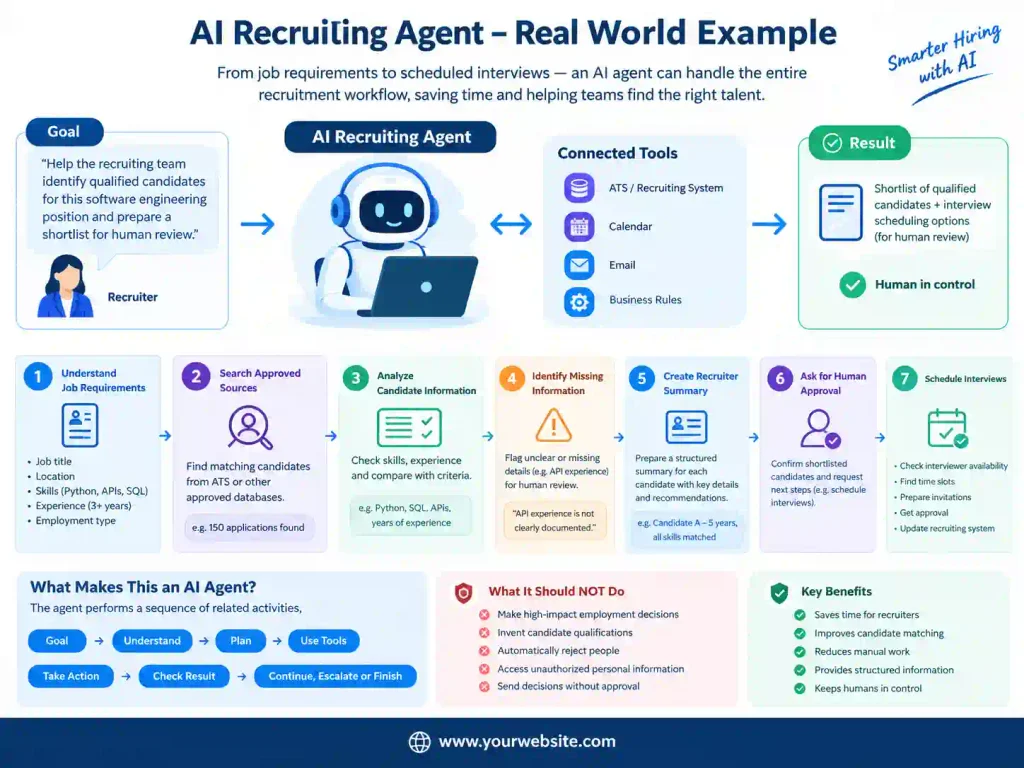
Practical AI Agent Example: How an AI Recruiting Agent Works in the USA
To understand AI agents more clearly, consider a practical example from the U.S. recruiting industry.
Imagine a company in the United States needs to hire a software engineer. Instead of using AI only to write a job description, the company creates an AI Recruiting Agent connected to its approved recruiting tools.
The agent is given a goal:
“Help the recruiting team identify qualified candidates for this software engineering position and prepare a shortlist for human review.”
The agent does not simply provide a text response. It can be designed to work through a multi-step workflow.
Step 1: Understand the Job Requirements
The recruiter provides information such as:
- Job title: Software Engineer
- Location: Austin, Texas
- Required skills: Python, APIs, SQL
- Experience: 3+ years
- Employment type: Full-time
The AI agent converts these requirements into a structured set of criteria.
Step 2: Search Approved Sources
The agent can use authorized recruiting databases, an applicant tracking system (ATS), or other approved sources.
It searches for candidates whose profiles match the defined requirements.
For example, it may identify 150 potentially relevant applications.
Step 3: Analyze Candidate Information
The agent can organize candidate information according to predefined criteria.
For example:
| Candidate | Python | SQL | API Experience | Experience | Status |
|---|---|---|---|---|---|
| Candidate A | Yes | Yes | Yes | 5 years | Review |
| Candidate B | Yes | No | Yes | 4 years | Review |
| Candidate C | Yes | Yes | Yes | 7 years | Review |
The purpose is to help the recruiter organize information—not to make an unchecked employment decision.
Step 4: Identify Missing Information
Suppose a candidate’s profile does not clearly indicate their experience with a required technology.
Instead of assuming that the candidate does or does not have the skill, the agent can flag the missing information:
“API experience is not clearly documented. Human review recommended.”
This is an important example of how an agent can be designed to recognize uncertainty.
Step 5: Create a Recruiter Summary
The agent can prepare a structured summary for the recruiter.
For example:
Candidate A
- Relevant experience: 5 years
- Python: Documented
- SQL: Documented
- API development: Documented
- Missing information: None identified
- Recommendation: Review profile
The recruiter can then examine the original application and supporting information.
Step 6: Ask for Human Approval
Rather than automatically rejecting candidates or making a final hiring decision, the workflow can require human review.
For example:
AI Agent: “I identified 12 applications that match the specified technical criteria. Would you like me to prepare interview scheduling options for the candidates selected by the recruiter?”
The recruiter remains responsible for the decision.
Step 7: Schedule Interviews
After the recruiter selects candidates, the agent can use an approved calendar system.
It can:
- Check the interviewer’s available times.
- Identify possible time slots.
- Prepare interview invitations.
- Ask for approval.
- Schedule approved meetings.
- Update the recruiting system.
This is where the system becomes more than a simple chatbot.
The agent is connecting:
AI Model + Recruiting System + Calendar + Email + Business Rules
What Makes This an AI Agent?
The important part is not simply that AI is being used.
The agent is performing a sequence of related activities:
Understand Goal
↓
Collect Information
↓
Analyze Information
↓
Identify Missing Data
↓
Use Tools
↓
Prepare Results
↓
Request Human Approval
↓
Take Authorized Action
This is an example of an agentic workflow.
What the AI Agent Should NOT Do Automatically
A responsible recruiting system should not be given unlimited authority.
For example, the agent should not independently make high-impact employment decisions based on protected characteristics or inappropriate personal information.
It should also not:
- Invent candidate qualifications
- Automatically reject people because information is incomplete
- Make unsupported judgments about candidates
- Access unauthorized personal information
- Send employment decisions without appropriate authorization
Instead, the system can use guardrails and human review.
Another Simple Example: AI Customer Support Agent
Consider a U.S. online retailer.
A customer sends:
“My order hasn’t arrived yet. Can you check the status?”
An AI customer-support agent could:
1. Understand the request
Identify that the customer wants an order-status update.
2. Access the order system
Retrieve the order using authorized customer information.
3. Check shipping information
Determine whether the order is:
- Processing
- Shipped
- In transit
- Delivered
- Delayed
4. Apply company policy
Determine what response or action is permitted.
5. Respond to the customer
Provide the current status.
6. Escalate if necessary
If the order is significantly delayed or the customer requests a refund requiring approval, the agent can transfer the case to a human representative.
Why These Examples Matter
These examples show the fundamental difference between AI that generates an answer and AI that participates in a workflow.
A basic chatbot might say:
“You can check your order status on the company’s website.”
An agentic system could potentially:
Find the order → Check the status → Apply the appropriate policy → Prepare the response → Escalate or take an authorized action.
That ability to combine reasoning, tools, context, and actions is what makes AI agents particularly interesting for businesses in the United States and around the world.
The Basic Formula
A practical AI agent can be thought of as:
Goal
→ Understand
→ Plan
→ Use Tools
→ Take Action
→ Check Result
→ Continue, Escalate, or Finish
The more important the action, the more important it becomes to include permissions, monitoring, guardrails, and human oversight.
Frequently Asked Questions About AI Agents
What is an AI agent in simple terms?
An AI agent is an AI-powered software system that can work toward a goal by understanding information, planning steps, using tools, and taking authorized actions.
Is ChatGPT an AI agent?
ChatGPT is primarily an AI assistant, but modern AI assistants can include agentic capabilities such as tool use, task execution, and multi-step workflows. Whether a particular system qualifies as an “AI agent” depends on its architecture and capabilities.
Can an AI agent work without humans?
Some AI agents can perform tasks with a high degree of autonomy, but autonomy depends on the system’s design and permissions. Human approval can be required for sensitive or high-impact actions.
Are AI agents safe?
Safety depends on the AI model, data, tools, permissions, security controls, testing, monitoring, and human oversight. An AI agent should not automatically be trusted simply because it is capable of performing a task.
Do AI agents require coding?
Not always. Some platforms provide no-code or low-code ways to create agentic workflows. More advanced or customized agents generally require programming and software engineering skills.
What is the biggest advantage of AI agents?
One of their major advantages is the ability to combine AI reasoning with tools and actions, allowing them to assist with multi-step digital workflows rather than simply generating text.
What is the biggest challenge?
A major challenge is making agents reliable, secure, controllable, and predictable while still allowing them enough flexibility to accomplish useful tasks.
Conclusion
AI agents represent an important evolution in artificial intelligence.
Instead of simply answering questions, an AI agent can be designed to understand a goal, plan a workflow, gather information, use tools, take authorized actions, evaluate results, and continue working until the task is completed or human assistance is required.
In the United States, organizations across technology, finance, healthcare, marketing, customer service, software development, legal services, and e-commerce are exploring agent-based AI applications.
The opportunity is significant, but so are the challenges.
Successful AI-agent adoption will require more than powerful AI models. Organizations will also need:
Reliable data + Secure tools + Appropriate permissions + Strong guardrails + Monitoring + Human oversight
The future of AI agents is therefore not simply about creating systems that can do more things. It is about building systems that can do useful things reliably, securely, transparently, and under appropriate human control.