
Artificial Intelligence, commonly known as AI, has become one of the most important technologies of the modern world. From smartphones and search engines to healthcare, education, banking, transportation, business, and job recruitment, AI is increasingly becoming part of everyday life.
But an important question remains: Is AI beneficial or harmful?
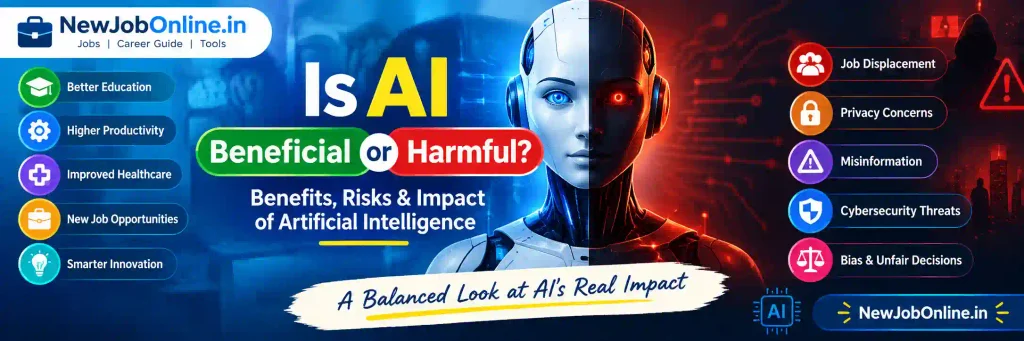
The answer is not simply “good” or “bad.” Artificial Intelligence can provide enormous benefits when it is developed and used responsibly. At the same time, careless or unethical use of AI can create serious risks, including misinformation, privacy concerns, job disruption, cybersecurity threats, and excessive dependence on technology.
Therefore, understanding both sides of AI is important for students, job seekers, professionals, businesses, and ordinary internet users.
In this article, we will discuss the advantages and disadvantages of Artificial Intelligence, its impact on jobs and education, possible risks, and what the future of AI may look like.
What Is Artificial Intelligence?
Artificial Intelligence is a technology that enables computer systems and machines to perform tasks that normally require human intelligence.
These tasks can include:
- Understanding language
- Recognizing images and speech
- Analyzing large amounts of data
- Finding patterns
- Generating text and images
- Making predictions
- Supporting decision-making
- Automating repetitive tasks
- Translating languages
- Answering questions
Modern AI systems can process enormous amounts of information much faster than humans. Generative AI can also create text, images, audio, video, software code, and other forms of content.
AI is therefore not a single technology. It is a broad field that includes machine learning, deep learning, natural language processing, computer vision, robotics, and other technologies.
Is AI Beneficial or Harmful?
AI can be both beneficial and potentially harmful, depending on how it is designed, deployed, and used.
For example, AI can help doctors analyze medical information, assist students with learning, help businesses automate repetitive work, and make some digital services easier to use.
However, the same technology can also be misused to create fake information, automate scams, invade privacy, manipulate people, or conduct cyberattacks.
The key issue is therefore not only the technology itself but also how humans use and control it.
Major Benefits of Artificial Intelligence
1. AI Saves Time
One of the biggest advantages of AI is its ability to complete repetitive tasks quickly.
Tasks that may take humans hours can sometimes be completed by AI-assisted systems in a much shorter period.
For example, AI can help with:
- Data analysis
- Document summarization
- Email drafting
- Customer support
- Content organization
- Information classification
- Software development assistance
- Routine administrative tasks
This allows people to spend more time on creative, strategic, and human-centered activities.
2. AI Can Improve Productivity
AI tools can help individuals and organizations increase productivity.
A professional may use AI to summarize a long document, generate a first draft, analyze data, or organize information.
Similarly, businesses can use AI for:
- Customer service
- Sales analysis
- Marketing research
- Inventory management
- Fraud detection
- Business forecasting
- Workflow automation
When used correctly, AI can act as a productivity assistant rather than simply replacing human work.
3. AI Can Support Healthcare
Healthcare is one of the areas where AI has significant potential.
AI-based systems can assist healthcare professionals with tasks such as analyzing medical images, identifying patterns in patient information, supporting research, and improving administrative processes.
Potential applications include:
- Medical image analysis
- Drug discovery
- Patient data analysis
- Clinical research
- Hospital administration
- Health monitoring
- Personalized treatment support
However, AI should not automatically replace qualified medical professionals. Medical decisions can involve complex factors that require human expertise, judgment, ethics, and communication.
4. AI Can Improve Education
Artificial Intelligence is changing the way students learn.
AI-powered educational tools can provide explanations, practice questions, language assistance, personalized learning support, and feedback.
For example, a student struggling with mathematics may ask an AI system to explain a concept step by step.
AI can also help teachers by assisting with:
- Lesson planning
- Educational material creation
- Question generation
- Student feedback
- Administrative work
- Learning resource organization
The best educational use of AI is generally one that supports learning rather than encouraging students to avoid thinking for themselves.
5. AI Can Help People With Disabilities
AI can improve accessibility for people with different disabilities.
Examples include:
- Speech-to-text systems
- Text-to-speech systems
- Image descriptions
- Automatic captions
- Translation tools
- Voice-controlled interfaces
- Assistive communication systems
These technologies can make digital information and communication more accessible to a wider range of people.
6. AI Can Help Businesses
Businesses of different sizes are increasingly using AI to improve operations.
A small business may use AI for customer communication, content creation, data analysis, or administrative assistance.
Large organizations may use AI for:
- Predictive analytics
- Fraud detection
- Supply-chain optimization
- Customer service
- Recommendation systems
- Cybersecurity
- Marketing analysis
AI can therefore create opportunities for businesses to improve efficiency and develop new products and services.
7. AI Can Assist Scientific Research
Scientific research often involves analyzing huge quantities of information.
AI can help researchers identify patterns, analyze datasets, simulate processes, and explore possible relationships within complex information.
AI is being explored across fields such as:
- Biology
- Chemistry
- Physics
- Climate science
- Astronomy
- Materials science
- Medicine
AI does not eliminate the need for scientists. Instead, it can become a tool that helps researchers explore questions more efficiently.
8. AI Can Improve Customer Service
Many organizations use AI-powered chatbots and virtual assistants to answer common customer questions.
AI can provide support at any time and can handle large numbers of routine inquiries.
This can be useful for:
- Banking
- E-commerce
- Telecommunications
- Travel
- Education
- Government services
- Software companies
However, customers should still have access to human assistance when a problem is complicated or sensitive.
9. AI Can Support Cybersecurity
AI can also be used to detect suspicious activity.
Security systems can analyze large quantities of network and transaction data to identify unusual patterns.
Potential applications include:
- Fraud detection
- Malware detection
- Network monitoring
- Account security
- Threat identification
At the same time, attackers can also use AI for malicious purposes. This creates an ongoing technological competition between cybersecurity defenders and attackers.
Potential Harms and Risks of Artificial Intelligence
While AI has many benefits, it also creates important risks.
1. Job Displacement
One of the most discussed concerns about AI is its impact on employment.
AI and automation can reduce the amount of human labor required for certain tasks. Some jobs may be transformed, while certain routine tasks may become automated.
Jobs involving highly repetitive digital processes may face greater automation pressure.
However, technological change can also create new occupations and increase demand for new skills.
For job seekers, this means that learning how to work with AI may become increasingly important.
2. AI Can Produce Incorrect Information
AI systems can sometimes generate information that sounds convincing but is incorrect.
This is an important issue because users may assume that an AI-generated answer is automatically accurate.
For important topics such as:
- Legal matters
- Medical information
- Financial decisions
- Government rules
- Employment requirements
- Academic research
users should verify important information using reliable sources.
AI should be treated as a tool for assistance, not an unquestionable authority.
3. Privacy Concerns
AI systems often depend on large amounts of data.
This creates questions about:
- What data is collected?
- How is it stored?
- Who can access it?
- How long is it retained?
- How is it used?
People should be careful about entering sensitive personal information into AI systems, especially when they do not understand how that information is handled.
4. Misinformation and Deepfakes
AI can make it easier to generate realistic-looking text, images, audio, and videos.
This can be useful for creative work, but it can also be misused.
AI-generated misinformation can include:
- Fake images
- Fake videos
- Fake audio
- False articles
- Impersonation
- Fabricated social media content
As generative AI becomes more capable, digital literacy and source verification become increasingly important.
5. Cybersecurity Risks
AI can be used by defenders and attackers.
Malicious actors may use AI to automate certain harmful activities, create convincing fraudulent messages, or increase the scale of cyber operations.
This means organizations need strong cybersecurity practices and responsible AI governance.
6. Bias in AI Systems
AI systems can sometimes produce biased results if their training data or design contains biases.
For example, an automated system used for hiring, lending, or other important decisions could produce unfair outcomes if it is not properly designed and tested.
Therefore, AI systems used for high-impact decisions require appropriate testing, monitoring, transparency, and human oversight.
7. Overdependence on Technology
Another potential problem is excessive dependence on AI.
If people use AI for every task, they may reduce opportunities to develop skills such as:
- Critical thinking
- Writing
- Problem solving
- Research
- Memory
- Decision-making
- Creativity
AI should ideally increase human capability rather than replace human thinking completely.
8. Copyright and Intellectual Property Questions
Generative AI has also created new questions about intellectual property.
People may use AI to generate text, images, music, software, and other creative works. This raises questions about training data, ownership, attribution, and the rights of creators.
The legal and policy environment around these issues continues to develop in different countries.
AI and the Future of Jobs
The relationship between AI and employment is more complicated than simply saying that AI will “take all jobs.”
AI is more likely to automate tasks within many jobs rather than eliminate every occupation entirely.
For example, a person working in an office may use AI to:
- Draft emails
- Analyze spreadsheets
- Prepare reports
- Summarize documents
- Research information
The employee still provides context, judgment, communication, responsibility, and decision-making.
This suggests that future employment may increasingly involve a combination of human skills and AI skills.
Skills That May Become More Important in the AI Era
As AI becomes more common, workers can benefit from developing both technical and human abilities.
Important skills may include:
Technical Skills
- AI literacy
- Data analysis
- Digital tools
- Basic programming
- Automation
- Cybersecurity awareness
- Prompt writing and AI interaction
Human Skills
- Critical thinking
- Communication
- Creativity
- Leadership
- Problem solving
- Emotional intelligence
- Collaboration
- Adaptability
The ability to understand when AI should and should not be used can also become an important professional skill.
AI in Education: Opportunity and Responsibility
Students can use AI as a learning assistant.
For example, AI can help students:
- Understand difficult concepts
- Practice languages
- Generate study questions
- Create revision notes
- Explore different explanations
- Improve writing
However, students should not use AI simply to avoid learning.
If a student submits AI-generated work without understanding it, the technology may provide a short-term shortcut but reduce the student’s long-term learning.
The most productive approach is to use AI to learn better, not to stop learning.
AI in Daily Life
Many people already interact with AI without realizing it.
AI can be present in:
- Search engines
- Smartphone assistants
- Social media recommendations
- Streaming platforms
- Online shopping
- Maps and navigation
- Spam filters
- Banking security
- Translation applications
- Photo enhancement tools
Therefore, AI is no longer only a technology used by large technology companies. It has become part of everyday digital life.
How to Use AI Responsibly
People can reduce the risks of AI by following some simple principles.
Verify Important Information
Do not blindly trust AI-generated answers for important decisions.
Protect Personal Information
Avoid sharing passwords, financial credentials, highly sensitive personal data, or confidential information with AI tools unless you understand the applicable privacy protections.
Keep Human Judgment
AI can provide suggestions, but people should remain responsible for important decisions.
Check Sources
For factual or important information, verify claims through reliable primary or authoritative sources.
Use AI to Learn
Use AI as a tutor, brainstorming partner, or productivity assistant rather than relying on it to do all your thinking.
Understand Limitations
AI systems can make mistakes, misunderstand context, or generate inaccurate information.
Is AI More Beneficial Than Harmful?
There is no universal answer that applies to every AI application.
The impact of AI depends on several factors:
- What the AI system is designed to do
- Who controls it
- What data it uses
- How accurate it is
- Where it is deployed
- Whether humans supervise it
- What safeguards are in place
- How users interact with it
An AI system used to assist a scientist with research is different from an AI system used to make an important decision about a person’s employment or access to services.
Therefore, evaluating AI requires looking at the specific use case, not just AI technology as a whole.
The Future of Artificial Intelligence
AI development is likely to continue influencing education, employment, healthcare, business, science, entertainment, and government services.
Future AI systems may become more capable of working with multiple types of information, including text, images, audio, video, and structured data.
At the same time, society will need to address important questions related to:
- Privacy
- Security
- Employment
- Copyright
- Bias
- Transparency
- Accountability
- Human oversight
- AI governance
The future of AI will therefore depend not only on technological progress but also on how responsibly people and institutions use the technology.
Conclusion: Is AI Beneficial or Harmful?
Artificial Intelligence is neither automatically beneficial nor automatically harmful.
It is a powerful technology with the potential to provide significant benefits while also creating serious risks.
AI can help people save time, improve productivity, support education, assist scientific research, improve accessibility, support healthcare, and create new opportunities.
At the same time, AI can contribute to job disruption, misinformation, privacy problems, cybersecurity threats, biased decisions, and excessive dependence on technology.
The most important approach is therefore responsible and informed use of AI.
For students and job seekers, learning about AI can be valuable because AI is becoming increasingly connected with the modern workplace. However, AI skills should be combined with human abilities such as critical thinking, creativity, communication, ethics, and problem-solving.
The future is unlikely to be simply “AI versus humans.” A more realistic question is how humans can use AI responsibly to increase their capabilities while maintaining appropriate human control.
Frequently Asked Questions About AI
Is AI good or bad?
AI can have both positive and negative effects. Its impact depends on how the technology is designed, deployed, regulated, and used.
Can AI replace human jobs?
AI can automate some tasks and may change the nature of certain jobs. It can also create new roles and increase demand for new skills. The impact varies significantly by occupation and industry.
Is AI safe to use?
AI can be useful when used responsibly, but users should understand its limitations, protect sensitive information, and verify important information.
Can AI make mistakes?
Yes. AI systems can generate incorrect or misleading information, even when their answers sound confident.
Should students use AI?
Students can use AI as a learning and productivity tool, but they should understand the material themselves and follow their school’s or institution’s rules regarding AI use.
Will AI control humans in the future?
AI development raises legitimate questions about control and governance, but specific future outcomes are uncertain. Human oversight, technical safeguards, laws, standards, and responsible development can influence how AI is used.
What skills should students learn for the AI era?
Students can consider developing AI literacy along with communication, critical thinking, creativity, problem-solving, adaptability, and other domain-specific skills.
Final Thought
AI is a tool. Its impact depends greatly on the people, organizations, and systems that design and use it.
Instead of asking only whether AI is beneficial or harmful, a more useful question is:
“How can we use AI to gain its benefits while reducing its risks?”
That question will become increasingly important as Artificial Intelligence continues to influence the way we work, study, communicate, and live.